
Paulownia Plantation Business Plan: Costs, Yields, and ROI
Build a realistic Paulownia plantation business plan. Evaluate establishment costs, timber and biomass revenue, carbon credits, and ROI drivers.
Plantation Establishment and Initial Capital Expenditure (CAPEX)
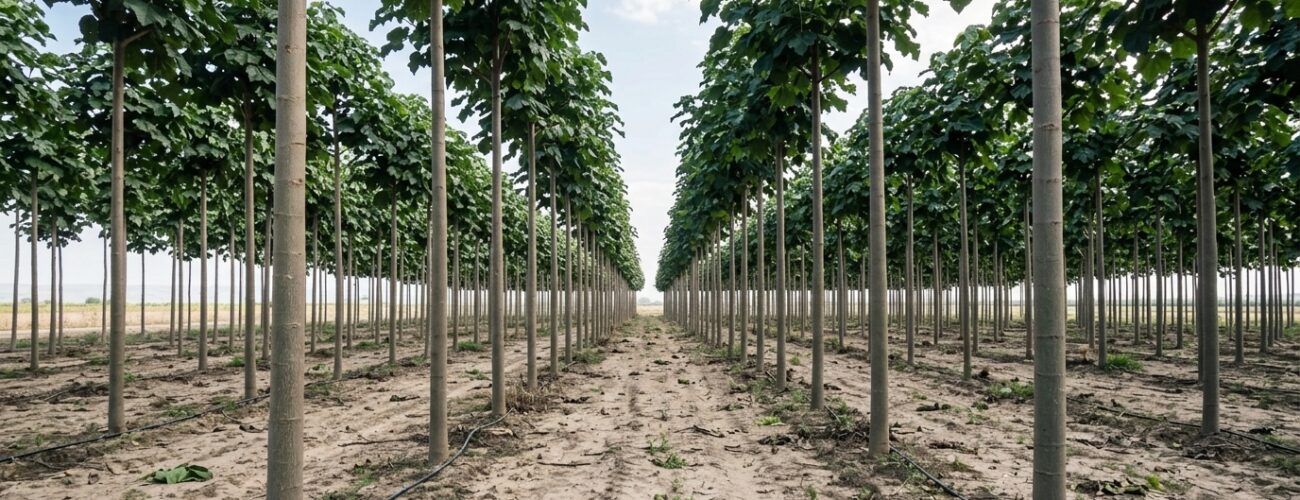
Establishing a commercial forest plantation requires meticulous upfront financial planning and disciplined agricultural execution. Key initial capital expenditure drivers per hectare include deep subsoiling, soil neutralization, weed suppression, and drip irrigation installation. Planting density depends directly on the intended output: wider spacing is used for high-value timber logs, whereas higher density grids maximize short-rotation woody biomass production. Economic analyses indicate that establishment costs for temperate European locations average several thousand euros per hectare in year one.
- Site Preparation and Infrastructure: Deep ripping down to 80 cm, land levelling, and installing drip irrigation lines represent essential upfront CAPEX investments.
- Planting Density Options: Timber production utilizes wider spacing to promote radial trunk growth, while biomass production uses tighter grids to maximize biomass volume per hectare.
- Certified Material Procurement: Procuring micropropagated Paulownia Clon InVitro 112® plantlets de-risks initial capital investments compared to uncertified seed stock.
Procuring uncertified seed stock or non-indexed hybrids exposes project developers to catastrophic financial loss through high genetic variability, stunted growth, and pathogen transmission. Leveraging our 35+ years of experience as a pioneering micropropagation laboratory founded in 1986, we guarantee complete genetic stability through in vitro multiplication of a single non-GMO genotype. To combat market fraud, every commercial delivery undergoes strict genetic testing protocols, protecting growers against legal consequences and ensuring full phytosanitary compliance across international operations.
Operational Maintenance and Ongoing Operational Expenditure (OPEX)
Maintaining optimal biomass accumulation and timber structural quality in a plantation project requires disciplined field management during the first three years. Ongoing operational expenditure (OPEX) covers precision drip irrigation, targeted nutrient delivery, mechanical weed suppressive treatments, and strategic formative pruning designed to secure perfectly cylindrical trunks. Because Paulownia Clon InVitro 112® exhibits exceptional genetic stability and vigor across diverse agroclimatic conditions, adhering to standardized cultural protocols directly minimizes cumulative labor inputs while maximizing final timber grade.
- Precision Irrigation and Fertigation: Regulated drip delivery systems maintaining adequate root-zone moisture during active growth periods, crucial in semi-arid environments.
- Mechanized Weed Control: Inter-row mowing and targeted under-canopy cultivation during years 1 to 2 to eliminate competition for soil moisture and nutrients.
- Formative Pruning and De-budding: Systematic removal of axillary buds and side branches during early growth cycles to foster a knot-free, perfectly cylindrical main bole.
- Phytosanitary Surveillance: Routine biological monitoring across both temperate and warm microclimates to ensure sustained vascular health and pest suppression.
Labor allocation is heavily concentrated in the initial two growing seasons, during which young trees establish extensive root systems. In semi-arid regions, annual water delivery must be carefully scheduled via automated fertigation lines to optimize nutrient assimilation without inducing anaerobic soil stress. In temperate zones, seasonal weed competition represents the primary operational focus. Systematic de-budding during the primary elongation phase forces growth vertically into the central stem, directly determining the proportion of high-value, knot-free timber harvested at rotation maturity. Routine phytosanitary protocols further protect plantation equity against opportunistic foliar pathogens, ensuring long-term yield consistency across commercial project sites.
Revenue Stream 1: High-Value Sustainable Timber Yields
The primary revenue driver for commercial forestry developments is high-grade timber production. Based on our extensive field trials across Europe, Paulownia Clon InVitro 112® achieves an empirical growth benchmark of approximately 1 m³ of usable wood per tree at 10 years under optimized cultivation protocols. When evaluated at standard market pricing of 200 €/m³, a single harvest cycle delivers robust commercial returns per hectare. Unlike non-registered seedling populations that exhibit high mechanical variability, our micropropagated clone guarantees uniform growth rates and predictable stem geometry for industrial wood processors.
Structural Benchmarks and Industrial Applications
Often characterized in material science as “aluminium timber” or the aluminium of utility woods, the sawn wood of Paulownia Clon InVitro 112® is significantly lighter than comparable hardwoods while exhibiting structural resistance to deformation. Independent physical evaluations conducted by AIDIMA (Technological Institute of Furniture, Wood, Packaging and Allied Industries) confirm an average dry density of 237 kg/m³, easy gluing performance, and excellent thermal insulation properties. In addition, its tangential-to-radial shrinkage ratio of 1.6 guarantees superior dimensional stability, drastically reducing splitting or warping during industrial drying processes.
| Timber Specification | Scientific Benchmark | Target Industry Application |
|---|---|---|
| Wood Density (AIDIMA) | 237 kg/m³ | Aviation structures, caravans, and light transit vehicles |
| Shrinkage Ratio (Tangential/Radial) | 1.6 | High-stability interior paneling, furniture, and cabinetry |
| 10-Year Timber Yield | 1 m³ per tree | Structural plywood, prefabricated timber, and core stock |
| Commercial Valuation | 200 €/m³ | Shipbuilding, surfboards, and specialty light craft |
Because our micropropagation protocols eliminate genetic drift, plantation managers can reliably deliver high-spec wood to demanding sectors such as nautical construction, commercial vehicle bodywork (trucks, trains, buses), and lightweight interior furnishings, securing premium off-take agreements over standard timber commodities.
Revenue Streams 2 to 4: Biomass, Verified Carbon Credits, and Agroforestry Honey
While high-grade timber provides the primary long-term return for commercial forestry projects, Paulownia Clon InVitro 112® yields substantial secondary revenue streams. Utilizing a fast-growing C4 photosynthesis pathway hybrid of Paulownia elongata and Paulownia fortunei, our registered clone allows project managers to diversify early cash flows through bioenergy biomass, certified carbon sequestration, and high-value agroforestry honey.
| Revenue Stream | Annual Yield / Capacity | Estimated Market Value |
|---|---|---|
| Bioenergy Woody Biomass | Up to 30 Tm/ha | 78 €/ton |
| Carbon Credit Monetization | 15–35 tonnes CO₂/ha/year | 400–700 €/ha/year |
| Agroforestry Honey Production | Approximately 700 kg/ha | Local market rates |
For bioenergy production, Paulownia Clon InVitro 112® generates up to 30 Tm/ha per year under standard high-density cultivation parameters. The wood offers exceptional fuel characteristics, including a highly competitive calorific value, low ash content, and minimal corrosive chlorine emissions. Valued at approximately 78 euros per ton in European economic models, biomass harvesting provides significant intermediate returns between primary timber rotations.
Environmental monetization further enhances annual plantation economics. Due to its rapid growth and high leaf area index, Paulownia Clon InVitro 112® fixes between 15 and 35 tonnes of CO₂ per hectare per year, as verified in peer-reviewed forestry literature and scientific data models. Simultaneously, the clone’s abundant flowering supports complementary beekeeping, yielding approximately 700 kg of premium honey per hectare annually. Together, these secondary revenue channels strengthen total risk-adjusted yields and provide early operational liquidity.
Payback Timeline, Coppice Cycles, and Key ROI Drivers
The cash flow structure of a commercial forestry project is fundamentally reshaped by the rapid growth rates of Paulownia Clon InVitro 112®. Unlike traditional hardwood forestry that requires decades of non-yielding capital lockup, our micropropagated hybrid delivers early liquidity and structured capital payback. Project managers can monetize early biomass thinnings by year 3, generating immediate cash flow while optimizing stand density for high-value sawlog development.
| Plantation Stage | Operational Event | Growth Metric | Economic Contribution |
|---|---|---|---|
| Years 1-2 | Establishment and canopy closure | Root architecture development | Annual CO2 offset monetization |
| Year 3 | Biomass thinning cut | Biomass volume harvest | Early revenue from bioenergy feedstock |
| Year 7 (First Cut) | Primary timber harvest | 32 cm average DBH | High-margin industrial wood sales |
| Year 15 (Second Cut) | Coppice regrowth harvest | 37 cm average DBH | Timber revenue without replanting CapEx |
The primary financial multiplier in this operational model is the biological coppicing capability of IN VITRO SL micropropagated stock. Following the primary harvest at year 7, the vigorous root system remains intact, driving accelerated trunk regeneration without requiring land preparation, tillage, or additional plant material acquisition. According to empirical plantation data, this regrowth reaches a superior average diameter at breast height (DBH) of 37 cm by year 15 for the second harvest cut.
Over the full operational lifespan of a plantation, up to six productive coppice cycles can be achieved from a single initial planting investment. By eliminating replanting capital expenditures across subsequent rotations, the effective cost per cubic meter of timber produced declines significantly. This compounding efficiency shortens the cumulative payback period, de-risks long-term capital allocation, and maximizes net present value for institutional forestry developers.
De-Risking Investment Through Certified Micropropagated Material
For commercial forestry project managers, capital misallocation often stems from uncertified, phenotypically variable planting stock. Sourcing unverified hybrids risks high field mortality, non-uniform timber growth, and severe regulatory non-compliance. Over our 35+ years of experience as a pioneering micropropagation laboratory founded in 1986, IN VITRO SL has systematically eliminated these operational vulnerabilities through strict biotechnological quality control. Cultivated via in vitro multiplication from a single selected genotype, Paulownia Clon InVitro 112® guarantees absolute genetic stability and growth uniformity across all soil profiles, securing predictable capital returns.
Regulatory Compliance and Verification Framework
Regulatory exposure presents a critical financial risk for European forestry developments. Non-native Paulownia varieties face stringent ecological prohibitions under Real Decreto 630/2013 in Spain. However, comprehensive research under project PBI06-0161 conducted by the Universidad de Castilla-La Mancha (UCLM) established that Paulownia Clon InVitro 112® produces non-viable, sterile seeds. Consequently, our proprietary non-GMO C4 hybrid is legally classified as non-invasive, ensuring official biosecurity compliance across commercial operations.
- 10-Year Field DUS Validation: Official testing by UCLM confirmed Distinctness, Uniformity, and Stability across multi-year growth cycles.
- Genetic Traceability Protocols: Advanced DNA testing safeguards asset owners against market fraud and uncertified competitor stock.
- Phytosanitary Assurance: Controlled laboratory micropropagation ensures virus-free material, preventing systemic plantation failure.
By grounding timber projects in verified official certifications, project managers protect long-term internal rates of return against ecological sanctions and biosecurity hazards.
Strategic Framework for Building a Paulownia Plantation Business Plan
Building a bankable business plan for commercial forestry requires moving beyond generic growth estimates to site-specific financial modeling. Drawing on our 35+ years of experience in micropropagation and plant biotechnology since 1986, we advise forestry project managers to integrate precise agroclimatic parameters with validated biological growth curves. By utilizing certified micropropagated plants such as Paulownia Clon InVitro 112®, project managers establish a predictable biological foundation that minimizes field mortality and maximizes capital efficiency.
Core Components of the Financial Model
- Site Characterization and Agroclimatic Matching: Conduct soil analyses for pH, electrical conductivity, and drainage capacity, while confirming local temperature tolerances (-25 °C to +45 °C) and annual precipitation.
- Yield and Harvesting Schedule: Model primary timber harvest yields at year 7 alongside intermediate biomass thinning, incorporating up to six coppice rotations from a single planting investment.
- Multi-Stream Off-Take Integration: Secure prospective purchase agreements across distinct market channels, including high-grade timber, bioenergy feedstock, and certified carbon offset programs.
- Sensitivity and Risk Modeling: Stress-test project cash flows against fluctuations in timber pricing, carbon credit values, and operational expenditure over a 10-year investment horizon.
Sensitivity analysis is essential when evaluating long-term real-asset returns. Financial models must stress-test revenue projections against price variations in timber markets and carbon offset valuations, which depend on sequestration rates ranging from 15 to 35 tonnes of CO2 per hectare annually. De-risking these economic variables relies directly on crop uniformity. Unregistered seed-propagated trees display unpredictable growth and high volumetric variance, whereas our genetically stable micropropagated clones deliver homogenous trunk diameters and predictable timber yields, securing investment returns across multiple rotation cycles.
Frequently asked questions
What are the initial establishment costs for a Paulownia plantation per hectare?
Initial establishment costs cover land preparation, irrigation installation, labor, and certified planting stock. Choosing certified micropropagated plants like Paulownia Clon InVitro 112® ensures optimal field survival and uniform growth rates.
How many revenue streams can a Paulownia plantation generate?
A commercial Paulownia plantation generates revenues through high-value industrial timber, bioenergy biomass yielding up to 30 Tm/ha, certified carbon offset credits absorbing 15 to 35 tonnes of CO2 per hectare annually, and secondary agroforestry honey.
What is the expected payback timeline for a Paulownia investment?
Payback timelines depend on the production focus. Biomass harvest cycles begin within 3 years, while high-value timber achieves initial harvest at 7 years averaging 32 cm DBH, followed by automated regrowth for a second cut at 15 years.
How does coppicing improve the internal rate of return (IRR) for forestry projects?
Coppicing allows stumps to regenerate rapidly after harvest without requiring land re-preparation or seedling purchases. Paulownia Clon InVitro 112® supports up to 6 productive coppice cycles, drastically lowering long-term operational costs.
Why is certified planting material essential for de-risking a plantation business plan?
Uncertified seedlings risk high mortality, genetic variation, and non-compliance with invasive species regulations. Certified material like Paulownia Clon InVitro 112® provides CPVO-registered genetic stability, non-invasiveness, and official DUS verification.
Comments are closed