
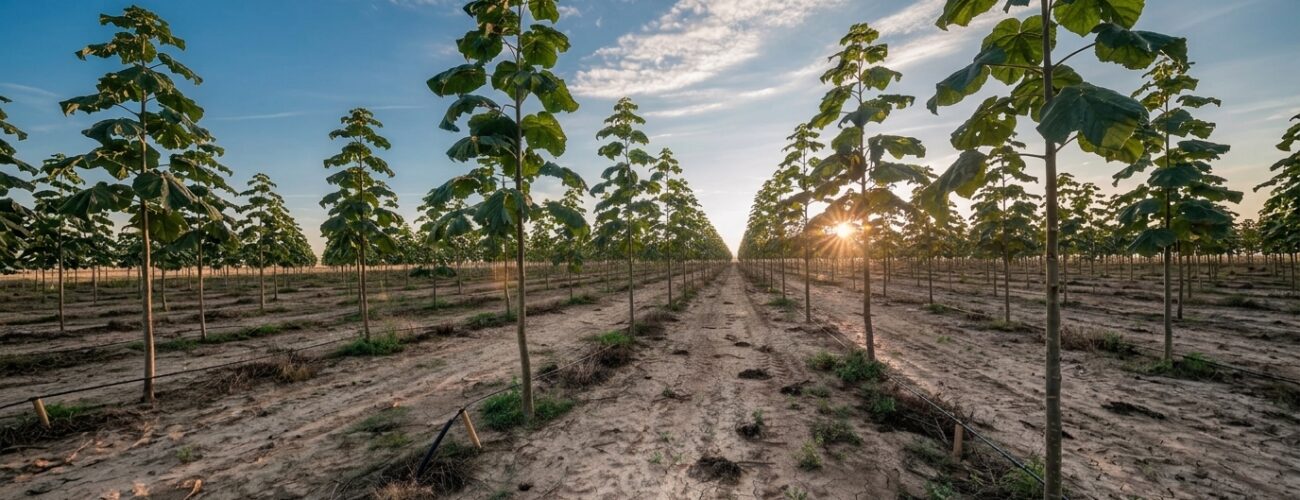
Paulownia Trees per Hectare: Density for Timber vs Biomass
Calculate optimal Paulownia trees per hectare for timber vs biomass. Compare 3×2 m and 5×5 m planting grids, rotation schedules, and yield forecasts.
Timber vs Biomass: Two Distinct Commercial Planting Strategies
At IN VITRO SL, with over 40 years of experience in plant tissue culture since our founding in 1986, we emphasize that commercial success in micropropagated silviculture begins with aligning spatial distribution with end-use objectives. Determining the optimal trees per hectare requires a strict structural trade-off between maximizing individual trunk diameter for high-value sawlogs and maximizing total volumetric yield per hectare for bioenergy. Because Paulownia Clon InVitro 112® is a fast-growing, non-GMO C4 photosynthesis pathway hybrid of Paulownia elongata and Paulownia fortunei developed in vitro, its intense photosynthetic capacity demands careful crown management to avoid canopy overlap and maintain explosive vegetative growth.
Structural Trade-Offs in Spatial Configuration
In high-density biomass grids, high stem competition restricts radial increment while maximizing total dry weight per hectare. Conversely, timber production relies on wider arrangements, such as 5×5 m (400 trees per hectare)[1], ensuring full solar radiation intercept and uninhibited secondary diameter growth to meet target log specifications. Furthermore, planting geometry dictates machinery passability; narrower inter-row corridors require specialized harvesting equipment, whereas 5 m spacing allows standard agricultural tractors to access rows for subsoiling, irrigation maintenance, and weed control.
| Parameter | Timber Production | Biomass Production |
|---|---|---|
| Standard Spacing | 5×5 m | 3×2 m |
| Planting Density | 400 trees/ha | 1,666 trees/ha |
| Primary Objective | Maximizing trunk diameter and cylindrical log quality | Maximizing total dry tonnage volume per hectare |
| Harvest Interval | 8–10 year single rotation | 2–3 year coppice rotation |
| Equipment Access | Standard machinery access across rows | Requires narrow agricultural or specialized forestry equipment |
Selecting the correct density from day one ensures that light competition within the C4 canopy aligns precisely with your financial harvest goals, establishing predictable operational workflows.
Recommended Spacing and Trees per Hectare: Density Options
When designing a commercial establishment, selecting the precise spatial layout determines root competition, canopy closure rate, and final trunk diameter at breast height. For Paulownia Clon InVitro 112®, planting density must directly align with the primary commercial objective: high-value sawlog production or rapid biomass accumulation.
| Commercial Goal | Grid Spacing | Plant Density | Primary Harvest Target |
|---|---|---|---|
| High-Value Sawlog Timber | 5 × 5 m | 400 trees/ha | Large-diameter cylindrical trunks |
| Timber Production (thinning) | 4 × 4 m | 625 trees/ha | Intermediate poles and final timber |
| Short-Rotation Woody Biomass | 3 × 2 m | 1,666 trees/ha | Maximum green tons per hectare |
Timber vs. Biomass Spatial Grids
For high-value timber production, wide spatial distribution is mandatory. A 5×5 meter grid (400 trees per hectare) ensures sufficient photosynthetically active radiation reaches lower canopy layers without triggering premature lateral branching. This configuration enables individual stems to reach trunk diameters exceeding 35 cm DBH without inter-tree competition limiting growth. Alternatively, a 4×4 meter arrangement (625 trees per hectare) provides operational flexibility for progressive intermediate thinning, yielding mid-cycle bioenergy poles while leaving a final density of 300 to 400 high-grade timber stems.
Conversely, short-rotation woody crop regimes prioritize maximum volumetric yield per unit area. Under an intensive 4×2 meter framework (1,200 trees per hectare)[2], canopy closure occurs rapidly within the first growing season. This dense spatial distribution maximizes photosynthetic surface area per hectare, optimizing total dry weight output for bioenergy and pellet manufacturing. Because scientific data confirms the genetic uniformity of our micropropagated material, growers achieve predictable stand development across all density options.
Biomass Rotation Cycles and Coppicing Management
For commercial energy and industrial pellet production, cultivating Paulownia Clon InVitro 112® under short-rotation coppice (SRC) protocols provides a continuous, highly efficient bioenergy source. Operating at a dense grid, the crop is managed through recurring 2-to-3-year harvest cycles. Unlike traditional forestry species, Paulownia utilizes a highly efficient non-GMO C4 photosynthetic pathway coupled with a deep, expansive root system. After the primary harvest, this established root architecture drives exceptionally rapid vegetative shoot regeneration without requiring soil replanting.
Regrowth Dynamics and Shoot Selection
Following each harvest cut, the root stock produces multiple strong sprouts. To maintain optimal stem vigor and biomass accumulation, field teams perform systematic shoot selection early in the post-coppice spring, reserving the single dominant shoot per stump. Based on our 35+ years of experience and extensive field trials across Europe, this rigorous coppicing framework yields 30 to 50 tonnes of dry woody biomass per hectare annually, subject to irrigation and soil conditions.
- Initial Establishment (Year 1): Root system development and technical cut at ground level to synchronize stem uniformity across the plantation.
- First Biomass Harvest (Years 2-3): Initial mechanical coppicing harvest delivering high-density wood chips or raw material for pellet production.
- Regeneration Phase (Spring Post-Cut): Emergence of multiple shoots, followed by early shoot selection to retain a single dominant stem per rootstock.
- Recurring Coppice Cycles (Every 2-3 Years): Continuous multi-cut harvesting over a 20+ year plantation lifespan without root replacement.
The harvested biomass demonstrates outstanding fuel properties, including a high calorific value of 19,520 kJ/kg (4,669.85 kcal/kg) at 0% moisture and exceptionally low ash content. This continuous regenerative capability renders short-rotation Paulownia Clon InVitro 112® one of the most reliable and productive bioenergy crops for commercial biomass producers.
Timber Growth Timeline, Pruning, and Thinning Protocols
To produce high-value commercial sawlogs, establishing precise silvicultural protocols during the early plantation phase is essential. While our micropropagated Paulownia Clon InVitro 112® plantlets possess exceptional genetic vigor and uniform growth rates, realizing top-tier lumber demands systematic stem management and canopy control across an 8 to 10 year rotation cycle[3].
The core foundation of timber-grade bole development begins at the end of the first growing season. During late winter dormancy (months 10 to 12), foresters execute a technical cut (recepado) by pruning the young sapling back to ground level. Having spent its initial season developing a vigorous root system, the plant responds in spring by forcing a single, highly dominant vertical shoot. This flush of growth eliminates stem crooks, establishing a perfectly straight, cylindrical main trunk.
- Technical Cut (Year 1): Cut stems at ground level during winter dormancy to trigger a rapid, single-stem spring spurt with strong apical dominance.
- Axillary Bud Pruning (Years 2-3): Perform lateral desbrotado during active spring growth, removing side shoots before lignification to maintain a knot-free bole up to a height of 5-6 meters.
- Canopy Lift (Years 3-4): Maintain a clean lower stem and restrict live crown branches to the upper third of the tree height.
- Selective Thinning: In plantations established at initial intermediate densities, cull inferior or crowded stems to adjust final stocking down to target timber densities.
By adhering strictly to these pruning and density adjustments, growers protect wood structural integrity, optimize radial increment growth, and ensure individual crop trees generate up to 1 m³ of premium sawlog volume at final harvest.
Expected Yield, Wood Density, and Log Quality Standards
When managing timber plantations at a wide 5×5 meter grid (400 trees/ha), our proprietary hybrid Paulownia Clon InVitro 112® is engineered to yield approximately 1 m³ of commercial timber per tree at 8 to 10 years of growth. Planting density directly dictates trunk morphology: lower densities minimize inter-tree competition for light and subterranean nutrients, promoting continuous radial growth and perfectly cylindrical trunks without excessive vertical competition. Conversely, tight biomass configurations (3×2 meters) yield 30 to 50 tonnes of dry woody biomass per hectare annually, prioritizing total volume over individual log diameter.
- Timber harvest target: 1 m³ of high-value roundwood per tree at 8-10 years under a 5×5 m spacing framework.
- Biomass production yield: 30-50 tonnes per hectare per year under a 3×2 m short-rotation coppicing grid.
- Air-dry wood density: Approximately 237 to 310 kg/m³ (1 m³ of wood weighs approximately 310 kg), earning the industry epithet aluminium timber.
- Dimensional stability: Tangential to radial shrinkage ratio of 1.6, preventing warping and checking during rapid air drying.
Physical and mechanical testing validates that Paulownia Clon InVitro 112® combines ultra-lightweight density with high structural stability. The wood features an exceptionally favorable tangential to radial shrinkage ratio, which significantly reduces twisting and deformation during drying compared to standard hardwoods. Combined with easy gluing, rapid natural air-drying, and high thermal resistance, our micropropagated clone delivers consistent industrial roundwood tailored for high-strength applications in aviation, shipbuilding, and modular building panels.
Why Clonal Uniformity Makes Density Planning Predictable
When establishing high-density plantations, traditional seed-derived or non-registered Paulownia stock frequently exhibits severe phenotypic variation. Genetic divergence creates uneven canopy development, leading to stand suppression where dominant trees overshade weaker specimens, resulting in unpredictable biomass yield and irregular harvest schedules. As a pioneering micropropagation laboratory with over 35 years of experience since our founding in 1986, we resolve this variability through in vitro multiplication. Every plant of Paulownia Clon InVitro 112® originates from a single, selected genotype, ensuring genetic stability, identical growth rates, and uniform light interception across the entire planting grid.
Rigorous Scientific Validation and Environmental Safety
Our commitment to biological precision is backed by extensive empirical research. Technical field validation is documented in the official 10-year field DUS (Distinctness, Uniformity, and Stability) testing report conducted by the Universidad de Castilla-La Mancha (UCLM). Furthermore, Castilla La Mancha University research project PBI06-0161 demonstrated that Paulownia Clon InVitro 112® remains stable, homogeneous, and produces non-viable, sterile seeds. This biological safeguard prevents spontaneous spreading, confirming that the hybrid is not listed as an invasive species in Spain under Real Decreto 630/2013.
- Consistent Genetic Uniformity: Eliminates height variance, enabling equal access to sunlight and soil nutrients across wide or tight planting grids.
- 10-Year DUS Validation: Field testing by UCLM confirms stable physical and mechanical wood properties across multi-year rotation cycles.
- Sterile Seed Production: Non-viable seeds eliminate invasion risks and protect surrounding ecosystems in accordance with Real Decreto 630/2013.
- Verified Regulatory Protocols: Access our official genetic certification and comprehensive scientific data to review technical reports.
By combining true genetic stability with certified ecological safety, commercial growers can design high-density biomass grids or wide timber arrangements with complete operational predictability.
Plantation Density Planning Checklist for Commercial Growers
Drawing on over 35 years of micropropagation experience since our founding in 1986 in Sant Feliu de Llobregat, we advise commercial growers to execute a rigorous pre-planting protocol. Determining the optimal trees per hectare for Paulownia Clon InVitro 112® requires balancing subterranean soil physics, machinery clearance, irrigation capacity, and multi-harvest revenue streams prior to field establishment.
- Subsoiling and Root Zone Conditioning: Conduct deep subsoiling to a minimum depth of 80 cm[4] to shatter restrictive subterranean hardpans and enable unrestricted taproot extension. Combine deep ripping with surface harrowing and install a drip irrigation network engineered to deliver targeted moisture during the critical first growing season.
- Machinery Clearance and Row Configuration: Align row spacing with the width and turning radius of tractors and harvesters. A 5×5 m timber grid provides ample clearance for standard field machinery, whereas narrower biomass grids require narrow-track machinery or specialized harvesting heads.
- Target Density Allocation: Calibrate planting density strictly against end-use requirements, establishing 400 trees per hectare (5×5 m) for large-diameter timber logs or higher density spacing for biomass coppicing.
- Diversified Agroforestry Monetization: Integrate complementary revenue models by placing beehives in flowering stands to harvest honey, while registering the project in certified CO2 emission offset programs.
Adhering to this structured decision framework minimizes field management costs across multi-year growth cycles. When field preparation matches the high genetic stability of our micropropagated material, commercial plantations achieve optimum canopy closure, efficient resource allocation, and predictable timber yields.
Frequently asked questions
How many Paulownia trees per hectare are recommended for timber production?
For commercial timber production, a planting density of 300 to 400 trees per hectare is standard. A 5×5 meter spacing (400 trees per hectare) gives each tree adequate crown area and root volume to develop a straight trunk yielding usable wood after 8 to 10 years.
What planting density is optimal for Paulownia biomass production?
For woody biomass and bioenergy production, high-density planting schemes such as 3×2 meters (1,666 trees per hectare) or 4×2 meters (1,250 trees per hectare) are ideal. This arrangement maximizes total volume per hectare across short coppicing cycles of 2 to 3 years.
How does initial planting density affect Paulownia timber quality?
Higher initial density forces upright apical growth and suppresses lower lateral branches, promoting clear bole development. However, excessive crowding without scheduled thinning reduces stem diameter growth. Choosing wider final spacing like 5×5 meters ensures rapid diameter expansion while maintaining structural timber quality.
What is the rotation cycle for Paulownia timber versus biomass?
Biomass plantations operate on short 2 to 3 year harvest cycles using coppicing, where trees sprout vigorously from established root systems up to 5 to 6 consecutive rotations. Timber plantations follow an 8 to 10 year rotation cycle for the first harvest.
Why is clonal uniformity crucial when calculating trees per hectare?
Seed-grown Paulownia trees show high genetic variability, leading to uneven growth rates and suppressed neighboring trees in dense stands. Micropropagated Paulownia Clon InVitro 112® provides genetic stability verified by 10-year UCLM field trials, ensuring uniform canopy closure and predictable plantation yields.
Can you thin a high-density Paulownia plantation for early revenue?
Yes. Growers can plant an initial intermediate density, such as 4×4 meters (625 trees per hectare), and conduct selective thinning mid-rotation. Thinning harvests generate early biomass revenue while leaving 300 to 400 trees per hectare for the final timber harvest.
Comments are closed