
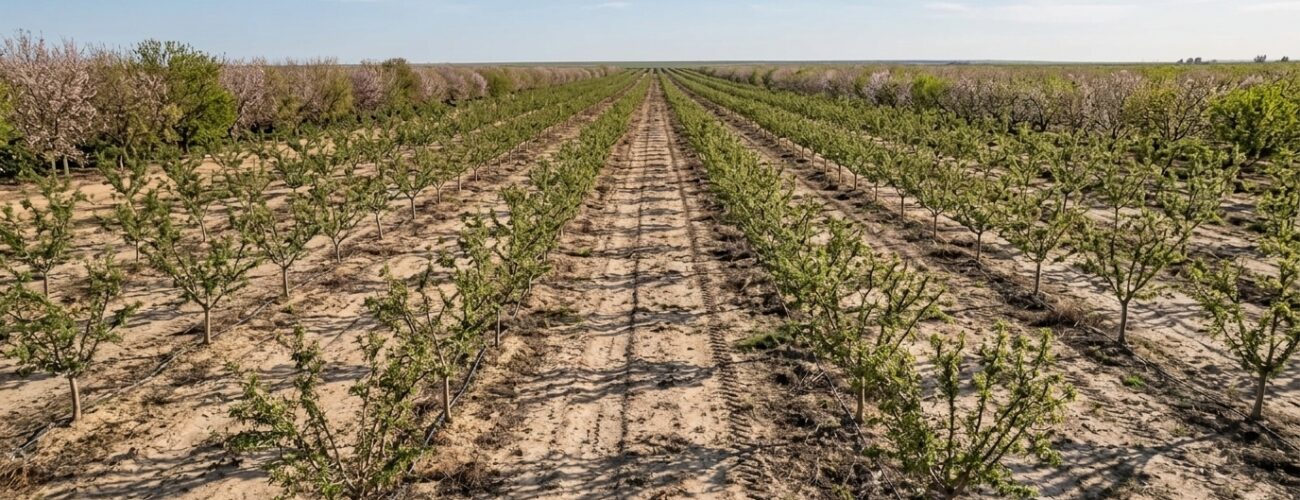
GF677 Rootstock: The Complete Guide for Almond and Peach Growers
Discover how GF677 rootstock enhances almond and peach orchard yield, withstands active lime up to 12%, and benefits from virus-free micropropagation.
Origin and Botanical Heritage of GF677 Rootstock
The GF677 rootstock is an interspecific hybrid of Prunus persica (peach) and Prunus dulcis (almond) originally selected by the Institut National de la Recherche Agronomique (INRA) in France.[1] Developed to overcome severe soil and climate constraints in stone fruit production, this natural cross combines the deep, extensive root system of the almond parent with the broad graft compatibility of the peach parent. As a pioneering micropropagation laboratory, IN VITRO SL brings years of experience to commercial tissue culture, becoming a leading laboratory in Spain. Through our specialized laboratorial processes, we supply disease-free, virus-free elite planting material that exhibits excellent genetic fidelity for industrial orchards worldwide.
The physiological traits of GF677 position it as the global benchmark for high-vigour almond and peach cultivation. The rootstock establishes a deep root system that enhances structural stability, nutrient uptake efficiency, and drought resistance across adverse agricultural terrains. Peach and almond varieties grafted onto GF677 exhibit enhanced foliar biomass and strong metabolic efficiency in alkaline soils.
- Genetic Origin: Interspecific cross of Prunus persica x Prunus dulcis selected by INRA France
- Vigour Index: High vegetative vigour inducing rapid trunk expansion and precocious canopy development
- Graft Compatibility: Universal compatibility with commercial almond, peach, nectarine, and select plum cultivars
- Sanitary Status: Micropropagated as disease-free, virus-free elite planting material with high genetic fidelity
- Adaptation Profile: Exceptional performance in calcareous, high-pH, and drought-prone Mediterranean soils
Commercial growers relying on traditional cutting or seed multiplication often face root system heterogeneity and latent pathogen transmission. In contrast, our micropropagated fruit tree rootstocks guarantee total clone sanitation and identical juvenile vigour. This scientific rigor ensures predictable orchard establishment, uniform fruit maturation, and decades of sustained agricultural productivity.
Active Limestone and Chlorosis Resistance in Calcareous Soils
Iron deficiency chlorosis poses a major physiological barrier for commercial stone fruit orchards in high-pH, calcareous Mediterranean soils. High concentrations of active calcium carbonate immobilize ionic iron in the rhizosphere, inducing leaf yellowing, reduced photosynthetic efficiency, and severe stunting in sensitive rootstocks. The GF677 peach-almond hybrid overcomes this soil constraint through specialized root physiology. Upon sensing iron limitation, GF677 roots actively adapt to absorb bioavailable iron for rapid root uptake. This adaptive mechanism enables GF677 to thrive in alkaline soils, maintaining high active leaf iron content and robust SPAD chlorophyll values where standard peach seedling rootstocks exhibit severe chlorosis.
Physiological Adaptation Mechanisms in High-pH Soils
- Enhanced Ferric Chelate Reductase (FC-R) Activity: GF677 roots maintain elevated enzymatic reduction rates at the root-soil interface, transforming immobilized iron into absorbable Fe²⁺ ions under alkaline conditions.
- Proton Exudation and Rhizosphere Acidification: Active root proton pumping localized around feeding roots temporarily lowers soil pH within the micro-rhizosphere, enhancing micronutrient solubility.
- Sustained Chlorophyll Assimilation: Field evaluations confirm that GF677 preserves leaf active iron levels up to 26.4 mg/kg in calcareous soils, completely preventing interveinal chlorosis and supporting uninterrupted canopy development.
At IN VITRO SL, our 40 years of micropropagation experience ensure that every batch of GF 677 produced in our laboratory delivers 100% genetic fidelity and optimal phytosanitary status. By supplying disease-free, virus-free elite planting material, we empower commercial growers to establish uniform, high-vigour orchards on challenging calcareous terrain. Choosing certified micropropagated rootstocks ensures immediate root establishment, consistent nutrient translocation, and maximum yield potential from the initial growing season.
Drought Performance and Deep Root Architecture
The drought resilience of the GF677 rootstock stems directly from its hybrid genetic inheritance, combining the deep foraging root structure of Prunus amygdalus with the efficient nutrient transport of Prunus persica. In arid and rainfed Mediterranean climates, this interspecific root system penetrates deep subsoil layers to access lower water tables unavailable to shallow-rooted stone fruit varieties. This extensive root system maintains physiological turgor and photosynthetic efficiency during prolonged dry spells.
- Deep taproot penetration: Penetrates dense subsoil strata to capture deep-lying moisture reserves during prolonged drought conditions.
- Structural anchoring capacity: Supports heavy canopy loads and stabilizes trees across variable, sloped topographies.
- Hydraulic architecture efficiency: Maintains cell turgor and sustained nutrient translocation under severe water deficit stress.
- Uniform root biomass: Ensured through disease-free, virus-free elite planting material that guarantees 100% genetic fidelity across plantations.
Robust root anchoring is critical for high-yielding commercial orchards. As almond and peach trees mature, heavy fruit loads exert massive mechanical strain on the root structure. The expansive lateral and vertical root distribution of GF677 grounds the tree, preventing lodging under heavy yields or wind stress in challenging topographies. Backed by our 40 years of experience in plant tissue culture, IN VITRO SL supplies commercial growers with elite material produced through our micropropagation of rootstocks protocols. This guarantees disease-free, virus-free elite planting material with high genetic fidelity, delivering uniform root development and long-term orchard productivity.
Cultivar Compatibility and Optimal Soil Profiles for GF677
The GF677 rootstock (a natural hybrid of Prunus persica × Prunus dulcis) exhibits exceptional graft compatibility across virtually all commercial almond (Prunus dulcis), peach (Prunus persica), and nectarine cultivars. At IN VITRO SL, our tissue culture propagation protocols ensure high genetic fidelity, allowing commercial growers to establish orchards with complete physiological uniformity and robust graft union integrity. Whether grafted with high-yielding almond varieties like Guara or specialized stone fruit selections, GF677 establishes seamless vascular connections that promote efficient nutrient translocation and early orchard productivity.
Soil adaptation is where GF677 demonstrates its definitive advantage in Mediterranean and semi-arid agricultural environments. The rootstock thrives in well-drained, light-to-medium loamy soils and demonstrates superior tolerance to alkaline, highly calcareous soils with pH values up to 8.2 and elevated active lime content. Agronomic trials confirm that in calcareous soils containing 6.3% active calcium carbonate at pH 8.0, GF677 maintains high active iron concentrations (26.4 mg/kg) in leaf tissue, preventing iron-induced chlorosis without requiring supplementary synthetic chelate treatments[2]. However, heavy, poorly drained clay soils subject to prolonged waterlogging must be avoided to mitigate root hypoxia risks.
- Compatible Cultivars: Broad compatibility across commercial almond cultivars (e.g., Guara, Lauranne, Penta), peaches, nectarines, and select plum varieties.
- Optimal Soil pH Range: Thrives in alkaline soils ranging from pH 7.2 to 8.5.
- Calcareous Soil Resilience: Exceptional resistance to lime-induced iron chlorosis in soils with high active calcium carbonate.
- Preferred Soil Textures: Light to medium loams, gravelly soils, and dryland terrain with moderate-to-high drainage capacity.
- Material Specification: Delivered exclusively as disease-free, virus-free elite planting material produced in our pioneering micropropagation laboratory.
By selecting micropropagated rootstocks backed by 40 years of experience from our laboratory founded in 1986, agricultural enterprises protect their investment against soil-borne health risks and field heterogeneity.
Soil Waterlogging Susceptibility and Mitigation Strategies
While the peach-almond hybrid GF 677 exhibits exceptional drought endurance and calcareous tolerance, its primary physiological vulnerability is sensitivity to prolonged soil waterlogging. In heavy clay soils or poorly drained parcels, stagnant water rapidly reduces rhizosphere oxygen levels, leading to root asphyxiation and creating optimal environmental conditions for soil-borne fungal pathogens such as Phytophthora species. As a pioneering micropropagation laboratory, we emphasize that rootstock selection must be paired with rigorous land preparation to safeguard commercial investments.
Technical Cultural Practices to Mitigate Heavy Soil Risks
- Ridge Planting (Berm Construction): Establishing raised soil ridges above the standard grade moves the root crown above saturation zones, maintaining critical rhizosphere aeration in heavy clay profiles.
- Subsurface Drainage Systems: Installing targeted tile drains or performing subsoiling prior to orchard establishment prevents subsoil water pooling and facilitates rapid lateral runoff.
- Precision Irrigation Management: Utilizing pulse drip irrigation managed by automated soil capacitance sensors eliminates over-watering cycles that trigger hypoxia.
- Preventive Phytosanitary Protocols: Targeted preventive biological or chemical root dips during high-moisture periods protect root systems against opportunistic Phytophthora species.
By implementing these cultural interventions prior to planting, commercial growers can effectively neutralize the risk of root asphyxiation and disease, enabling high-density orchards to fully realize the vigorous growth and high yield potential of certified GF 677 starting material.
Nematode Susceptibility and Soil-Borne Pathogen Management
Despite its outstanding vigour and iron-chlorosis resistance in calcareous soils, the GF677 peach x almond hybrid exhibits known vulnerabilities to specific soil-borne pathogens. Most notably, GF677 is sensitive to Agrobacterium. When planted in replant sites or sandy soils with high nematode populations, gall formation on the root system disrupts vascular transport and weakens orchard establishment. IN VITRO SL emphasizes that starting with disease-free, virus-free elite planting material produced under strict aseptic protocols is essential to prevent introducing pathogens into clean soils.
Integrated Pre-Planting Soil Management Protocols
To mitigate pathogen risks before establishing commercial orchards on fruit tree rootstocks, growers must execute a structured pre-planting sanitation program. Controlling soil-borne threats requires combining diagnostic analysis with bio-physical soil remediation methods:
- Soil Diagnostic Nematode Testing: Conducting laboratory assays prior to ground preparation to quantify Meloidogyne juvenile populations and identify phytopathogenic fungi.
- Solarization and Bio-Fumigation: Utilizing transparent polyethylene mulching during summer heat peaks or incorporating brassica green manures to release bio-fumigant glucosinolates into the upper soil profile.
- Sanitary Irrigation and Equipment Protocols: Ensuring irrigation water sources are filtered and tillage machinery is sanitized to prevent pathogen cross-contamination between parcels.
Deploying micropropagated GF677 material with high genetic fidelity ensures maximum initial root vigour and uniform canopy establishment, helping young orchards withstand minor soil stressors when proper pre-planting protocols are maintained.
The Role of Virus-Free Micropropagated GF677 in Plantation Success
Since our establishment in 1986 as a pioneering micropropagation laboratory, we have consistently demonstrated that commercial orchard profitability begins at the cellular level. When establishing modern almond and peach plantations, utilizing disease-free, virus-free elite planting material derived from tissue culture is essential to eliminate latent viral pathogens such as Prunus necrotic ringspot virus and prune dwarf virus. Traditional vegetative propagation via hardwood cuttings often carries undetected viral complexes that degrade tree vigour, reduce flowering uniformity, and diminish cumulative yield over the orchard lifespan. Through controlled micropropagation of rootstocks, aseptic tissue culture guarantees high genetic fidelity while eradicating systemic pathogens.
- Eradication of Latent Viruses: Aseptic meristem culture cleanses starting plant material of graft-transmissible viruses, preventing systemic decline.
- High Genetic Fidelity: In vitro propagation ensures absolute clonal uniformity across every plantlet, eliminating field variability in vigour.
- Accelerated Field Establishment: Ex vitro acclimatized plantlets display active root systems, leading to rapid soil anchoring and earlier commercial production.
- Enhanced Physiological Resilience: Virus-free tissue-cultured GF677 maintains optimal nutrient absorption efficiency and drought tolerance.
With 40 years of experience in plant tissue culture, our laboratory subjects every batch of GF677 to rigorous phytosanitary screening and molecular quality controls before acclimatization. For commercial growers and agricultural developers, investing in certified micropropagated GF677 rootstocks secures high planting efficiency and maximizes long-term returns.
Frequently asked questions
What is GF677 rootstock?
GF677 is a natural hybrid between peach (Prunus persica) and almond (Prunus dulcis), selected by INRA in France. It is widely used across Mediterranean regions as a high-vigour rootstock for commercial almond, peach, and nectarine production.
How much active limestone can GF677 tolerate?
GF677 tolerates active limestone and high soil pH. Its specialized root system efficiently mobilizes soil nutrients, preventing iron-induced chlorosis even in highly calcareous Mediterranean soils.
Is GF677 suitable for dryland or rainfed orchards?
Yes, GF677 possesses a deep and expansive root architecture that offers excellent drought resilience. It performs reliably in rainfed or deficit-irrigated almond and peach plantations established in dry, light soils.
What are the primary weaknesses of GF677 rootstock?
GF677 is susceptible to heavy, waterlogged soils, which increase the risk of Phytophthora root rot. Additionally, it shows susceptibility to root-knot nematodes and crown gall, requiring proper soil testing and drainage management prior to planting.
Which crops and cultivars can be grafted onto GF677?
GF677 demonstrates wide graft compatibility with commercial almond cultivars, peaches, nectarines, and certain plum varieties. It induces strong scion vigour, rapid canopy expansion, and early fruit production.
Why should growers choose micropropagated GF677 rootstocks?
Micropropagated, tissue-cultured GF677 rootstocks ensure high genetic fidelity and elite virus-free status. Starting with certified pathogen-free plants prevents latent systemic diseases, ensuring uniform growth and long-term orchard productivity.
Comments are closed