
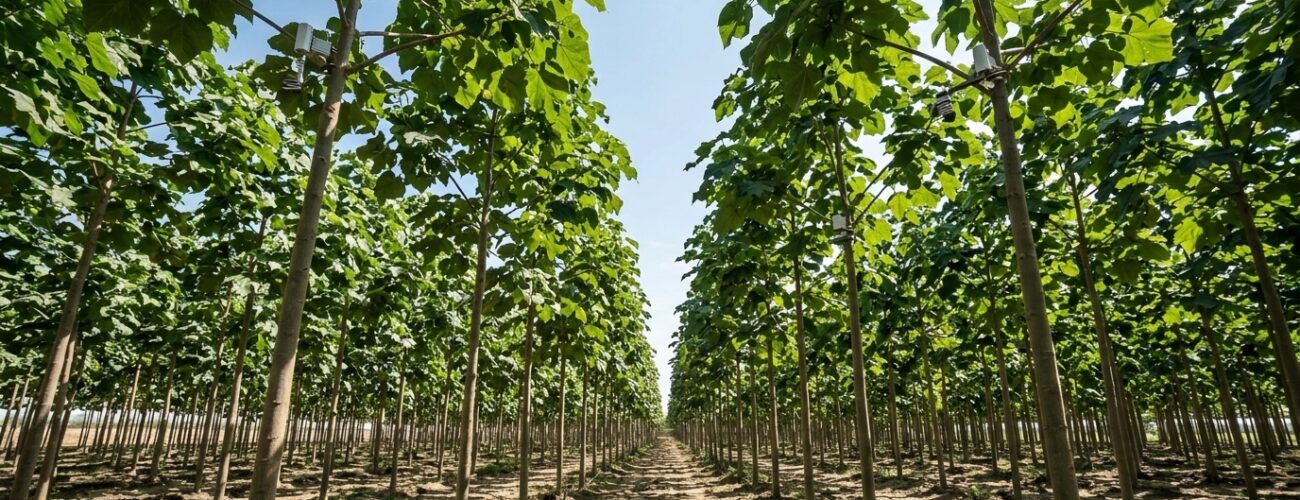
How Much CO2 Does a Paulownia Plantation Capture?
Discover how much CO2 Paulownia plantations capture per hectare, how UCLM LiDAR data supports carbon credits, and how to verify high-integrity offsets.
Why C4 Paulownia Hybrids Serve as High-Performance Carbon Sinks
At IN VITRO SL, as a pioneering micropropagation laboratory established in 1986, our multi-decade research focuses on deploying superior plant biotechnology to address global environmental and industrial demands. Most temperate and broadleaf forestry species utilize the C3 photosynthetic pathway, which suffers from metabolic efficiency losses due to photorespiration under high solar radiation and elevated ambient temperatures. In contrast, our proprietary Paulownia Clon InVitro 112® (a registered, non-GMO hybrid of Paulownia elongata and Paulownia fortunei) operates via the C4 photosynthetic pathway. This physiological trait delivers exceptional solar energy conversion and accelerated carbon fixation rates compared to traditional forest trees.
The structural separation of carbon assimilation in C4 plants minimizes photorespiratory carbon loss, allowing the tree to maintain elevated rates of net photosynthesis even under stress. When combined with a selected single genotype produced in vitro, this biological efficiency translates into rapid, uniform biomass accumulation. The massive surface area of the leaves acts as an expansive atmospheric filter, absorbing high volumes of CO2 per unit of canopy area.
- Superior photosynthetic pathway: C4 biochemistry eliminates photorespiratory efficiency losses, maintaining high net carbon fixation under intense heat and light.
- Expansive foliar capture: Exceptionally broad leaf surface area maximizes photon capture and carbon dioxide influx across the canopy.
- Rapid wood accumulation: High solar conversion efficiency drives rapid cellular growth, converting atmospheric carbon directly into stable trunk biomass.
- Agroclimatic resilience: Optimized stomatal control enables continuous assimilation across temperature extremes ranging from -25 to +45 degrees Celsius.
By leveraging the biological superiority of the C4 pathway within a genetically stable, micropropagated clone, forestry project managers can establish reliable, high-capacity biological carbon sinks capable of outperforming standard C3 reforestation models.
Quantifying CO2 Absorption: Empirical Metrics for Paulownia Clon InVitro 112®
In commercial forestry management, evaluating carbon sink capacity requires rigorous empirical validation rather than speculative estimates. Our micropropagated hybrid, Paulownia Clon InVitro 112®, utilizes a high-efficiency C4 photosynthetic pathway that provides a distinct physiological advantage over standard C3 temperate species. Multi-year field data demonstrate that established plantations deliver exceptional annual CO2 sequestration rates per hectare. This sequestration performance significantly exceeds average temperate hardwood forests, positioning the clone as a primary instrument for large-scale carbon mitigation. When compared directly to slow-growing temperate hardwoods such as oak or beech, our selected hybrid provides rapid climate impact alongside commercial timber production.
Carbon Accumulation Dynamics and Diameter Metrics
Unlike conventional forestry species where carbon uptake reaches an early plateau, the carbon accumulation curve for Paulownia Clon InVitro 112® is strongly convex. Annual sequestration rates accelerate as the tree matures, driven by rapid volumetric wood expansion and superior foliage canopy development. Independent protocols developed and validated by the University of Castilla-La Mancha (UCLM) enable precise calculation of individual tree carbon storage based on trunk diameter at breast height (DBH) measurements:
- 20 cm DBH: approximately 218 kg of CO2 stored per individual tree.[1]
- 30 cm DBH: approximately 673 kg of CO2 stored per individual tree.[1]
- 40 cm DBH: approximately 1,460 kg of CO2 stored per individual tree.[1]
Because sequestration rates compound exponentially as trunk diameter expands, carbon credit yields increase significantly in later plantation years rather than tapering off. This compounding trajectory allows forestry project managers to optimize crediting schedules and establish bankable financial forecasts. Project developers can access our full repository of scientific data to integrate these UCLM-validated growth models directly into certified carbon project designs.
Scientific Carbon Measurement: The UCLM Allometric and LiDAR Protocol
To issue bankable carbon credits that satisfy rigorous voluntary carbon market standards, carbon stock calculations must rely on deterministic, empirically verified methodologies rather than non-calibrated estimates. At IN VITRO SL, we validate the biomass and carbon sequestration capacity of Paulownia Clon InVitro 112® using non-destructive, high-precision protocols developed in collaboration with the University of Castilla-La Mancha (UCLM). A 2023 UCLM validation study conducted by Dr. Francisco R. López Serrano demonstrated that combining Mobile Terrestrial Laser Scanner (MTLS) LiDAR technology paired with specialized AID-FOREST software accurately estimates the aboveground and belowground dry biomass and carbon storage of individual Paulownia Clon In Vitro 112® trees with up to 96% accuracy[2].
Allometric Growth Curve and Carbon Accumulation Rates
The UCLM allometric model links individual tree trunk diameter at breast height (DBH) directly to accumulated carbon content. Because biomass accumulation in this fast-growing C4 hybrid follows a strongly convex curve, annual carbon fixation rates accelerate as the plantation matures. This predictable, mathematical relationship provides third-party auditors with a transparent verification framework.
| Trunk Diameter (DBH) | Calculated CO₂ Stored per Tree |
|---|---|
| 20 cm DBH | ~218 kg CO₂ stored |
| 30 cm DBH | ~673 kg CO₂ stored |
| 40 cm DBH | ~1,460 kg CO₂ stored |
By integrating individual DBH allometric equations with 3D canopy inventories derived from MTLS LiDAR point clouds, forestry project managers can generate repeatable carbon stock inventories across vast commercial plantations scientific data. This rigorous Monitoring, Reporting, and Verification (MRV) methodology provides institutional investors and carbon certification bodies with the auditable proof required to generate high-value carbon offset credits.
Carbon Credit Frameworks and MRV Standards for Forestry Projects
To monetize the carbon sequestration potential of Paulownia Clon InVitro 112® plantations, forestry project managers must align operational data with recognized voluntary carbon market standards. Modern standards, such as the Verra VM0047 methodology for Afforestation, Reforestation, and Revegetation (ARR), enforce strict remote-sensing and dynamic performance benchmarking to establish additionality and baseline scenarios. Converting biological carbon storage into bankable offset credits requires robust, auditable Monitoring, Reporting, and Verification (MRV) protocols that satisfy institutional carbon buyers.
Core MRV Requirements for High-Integrity Carbon Credits
In our work over 40+ years at IN VITRO SL, we have established rigorous quantification frameworks to support high-integrity offset generation. A compliant MRV pipeline under VM0047 and leading voluntary standards requires four primary operational phases:
- Baseline and additionality assessment: Establishing dynamic control plots or conservative zero-baseline scenarios to prove land-use conversion benefits.
- Inventory quantification: Utilizing direct diameter at breast height (DBH) measurements combined with non-destructive terrestrial or aerial LiDAR canopy scanning.
- Biomass-to-carbon conversion: Converting 3D point cloud inventories into precise aboveground and belowground dry biomass models with validated allometric equations.
- Third-party audit and issuance: Verifying measured carbon stock increases through independent accredited bodies before issuing serialized Verified Carbon Units (VCUs).
Our research collaborations with the University of Castilla-La Mancha (UCLM) demonstrate that pairing mobile terrestrial laser scanning with specialized forestry software accurately estimates carbon stock[3]. By combining elite plant genetics with verified scientific data, project developers establish transparent, bankable carbon assets that resist market volatility.
Ensuring Offsets Integrity: Traceability and Genetic Fraud Prevention
For forestry project managers generating carbon credits, regulatory compliance and ecological safety are paramount. Uncertified seed-derived trees or illegal clones pose significant ecological risks, including invasive spread and genetic instability, which can invalidate carbon offsets and expose operators to legal consequences. We ensure that Paulownia Clon InVitro 112® complies fully with environmental legislation. Specifically, it is not listed as an invasive species in Spain under Real Decreto 630/2013[4]. Research project PBI06-0161 conducted by Castilla La Mancha University confirms that this registered hybrid is phenotypically stable, homogeneous, non-invasive, and produces non-viable (sterile) seeds.
Verifiable Safeguards Against Market Fraud
The commercial success of high-yielding fast-growing clones has unfortunately led to unauthorized propagation and counterfeit distribution. Uncertified material derived from root cuttings or non-sterile seed populations lacks genetic uniformity and risks failing auditor scrutiny during Monitoring, Reporting, and Verification (MRV) cycles. To safeguard plantation assets and institutional carbon credit claims, we enforce rigorous certification and authenticity measures across our global supply chain.
- Genetic Testing Protocols: Every production batch undergoes microscopic verification in our micropropagation laboratory to guarantee 100% single-genotype purity and absolute sterility.
- Official EU Registration: Registered with the Community Plant Variety Office (CPVO) since 2011, establishing clear legal protection and origin traceability.
- Regulatory and Anti-Fraud Compliance: We actively track unauthorized propagation and enforce legal consequences against illicit distributors, protecting project developers from non-compliant stock.
- Auditable Phytosanitary Certification: Every shipment is backed by official phytosanitary certifications and genetic documentation required by international forestry auditors.
Drawing on our 40+ years of experience as a pioneering micropropagation laboratory, we provide complete transparency from laboratory culture to field deployment. By utilizing verified in vitro clones, project operators secure both ecological compliance and bankable offset integrity.
Revenue Diversification: Combining Carbon Credits with Timber and Biomass
Commercial forestry projects achieve optimal risk-adjusted financial returns by stacking carbon credit yields with commercial timber harvests. Because Paulownia Clon InVitro 112® features rapid C4 photosynthetic efficiency, a mature plantation sequesters 15 to 35 tonnes of CO2 per hectare annually, potentially generating an estimated EUR 400 to EUR 700 per hectare in annual voluntary carbon market revenue. This continuous cash flow optimally derisks the asset during the growth phase, while biomass co-products and high-grade utility timber provide substantial liquidity milestones at harvest, provided that there is a diversification within the plantation of Paulownia Con InVitro112®.
Our empirical plantation data confirms that sustainable coppicing maximizes long-term yield without disrupting subterranean carbon storage. Because the tree regenerates directly from its existing root network after cutting, project managers avoid soil disturbance and replanting costs. Often referred to as “aluminium timber” due to its high strength-to-weight ratio, the harvested wood exhibits an air-dry density of 231 to 237 kg/m³, making it 30% lighter than traditional hardwoods while maintaining exceptional dimensional stability for industrial applications[2].
| Project Phase | Timeline & Growth Metrics | Primary Revenue Stream |
|---|---|---|
| Annual Sequestration | Years 1 to 14 (Continuous) | Carbon credit issuance (15-35 t CO2/ha/yr) |
| First Biomass Harvest | Year 2-3 (~15 DBH) | Bioenergy Woody Biomass |
| First Timber Harvest | Year 7 (~32 cm DBH) | Lightweight utility timber and bioenergy biomass |
| Regrowth & Second Harvest | Year 15 (~37 cm DBH) | High-yield commercial timber from rootstock regrowth |
In addition to timber, thinning residues and dedicated biomass plantings on a 3×2 meter grid deliver up to 30 Tm/Ha of high-calorific fuel (19,520 kJ/kg at 0% moisture). With over 40 years of micropropagation experience, we provide certified, genetically uniform starting material that ensures predictable growth rates and bankable carbon offsets across international plantation projects.
Strategic Decision Checklist for Reforestation Project Managers
Establishing a bankable forest carbon project requires rigorous due diligence across every stage of plantation development. As a pioneering micropropagation laboratory founded in 1986, IN VITRO SL brings over 40+ years of experience to assist project developers in mitigating operational risk and securing institutional climate finance.
- Agroclimatic and Legal Suitability Assessment: Verify soil conditions, water availability, and agroclimatic tolerance. The fast-growing, non-GMO C4 photosynthesis pathway hybrid Paulownia Clon InVitro 112® (a hybrid of Paulownia elongata and Paulownia fortunei developed in vitro) thrives across temperature ranges from -25 °C to +45 °C. Confirm non-invasiveness under local regulations; for example, Castilla La Mancha University research project PBI06-0161 proved the clone is stable, non-invasive, and produces unviable, sterile seeds, ensuring it is not listed as an invasive species in Spain under Real Decreto 630/2013.
- Certified Material and Phytosanitary Verification: Procure strictly authenticated plantlets reproduced in vitro from a single genotype. To protect project capital from market fraud, enforce genetic testing protocols and pursue legal consequences against unauthorized sellers, verifying material against official certifications.
- Baseline Sequestration and Planting Grid: Establish baseline carbon stocks and select an optimal planting layout (such as a 3×2 meter grid for biomass or wider spacing for utility timber). Model sequestration curves based on scientific data demonstrating annual capture rates of 15 to 35 tonnes of CO₂ per hectare.
- MRV Protocols and Third-Party Audit Verification: Implement high-precision monitoring tools to satisfy voluntary carbon market standards. The 2023 University of Castilla-La Mancha (UCLM) validation study conducted by Dr. Francisco R. López Serrano confirmed that Mobile Terrestrial Laser Scanner (MTLS) LiDAR scanning paired with AID-FOREST software accurately estimates aboveground and belowground dry biomass and carbon storage in individual Paulownia Clon InVitro 112® trees using trunk diameter at breast height (DBH) measurements with up to 96% accuracy.
Adhering to this decision framework ensures that reforestation managers build fully traceable, audited carbon sinks capable of generating high-integrity carbon offsets alongside valuable timber and bioenergy crops.
Frequently asked questions
How much CO2 does a hectare of Paulownia Clon InVitro 112® absorb annually?
A mature plantation of Paulownia Clon InVitro 112® absorbs between 15 and 35 tonnes of CO2 per hectare each year under optimal agroclimatic conditions, representing up to 10 to 15 times the sequestration rate of standard temperate forests.
How is carbon storage calculated in a Paulownia plantation?
Carbon storage is calculated using University of Castilla-La Mancha (UCLM) validated allometric equations based on Diameter at Breast Height (DBH), supplemented by terrestrial LiDAR scanning and AID-FOREST software for plantation-scale canopy 3D modeling.
What carbon credit standards apply to Paulownia reforestation projects?
Projects typically align with Verra VCS methodology VM0047 for Afforestation, Reforestation, and Revegetation (ARR), requiring rigorous Monitoring, Reporting, and Verification (MRV) protocols to issue verified carbon units.
Why is genetic verification necessary for Paulownia carbon offset claims?
Genetic verification via molecular testing ensures the plantation utilizes the authentic, non-invasive, sterile hybrid Paulownia Clon InVitro 112®, protecting carbon projects from regulatory rejection or biosecurity non-compliance.
Can carbon credit generation be combined with timber harvesting?
Yes, fast-growing Paulownia Clon InVitro 112® allows project operators to generate carbon credits during growth phases while harvesting high-value utility timber at 7 and 14 years without sacrificing long-term rootstock carbon storage.
Comments are closed