
Why does Paulownia Clon In Vitro 112® open new possibilities for CO₂ sequestration?
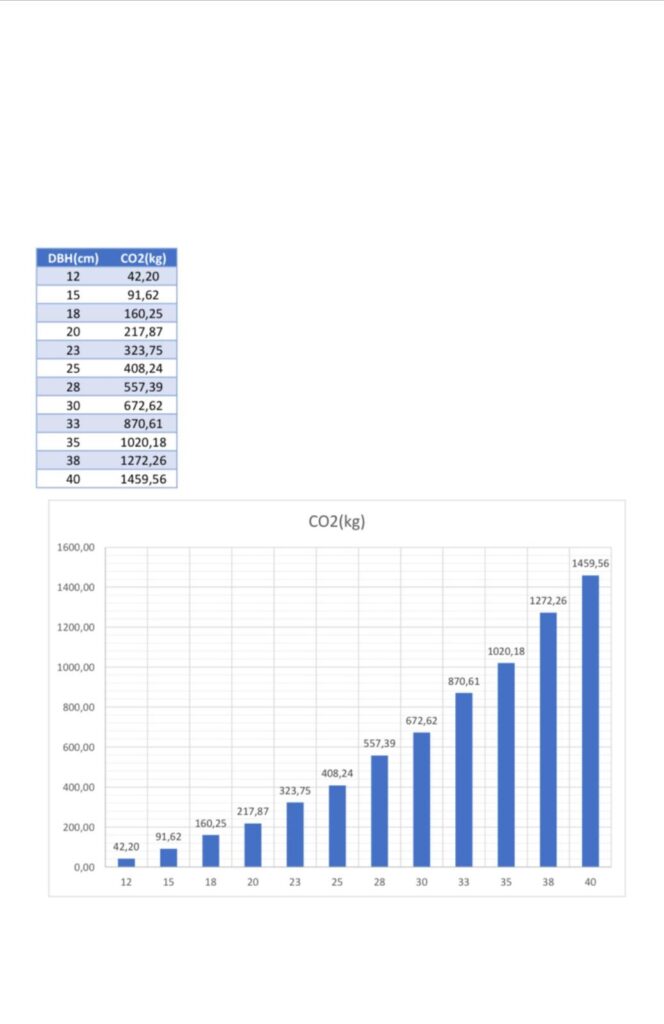
As the demand for credible climate solutions grows, Paulownia Clon In Vitro 112® stands out not only for fast biomass formation, but because its CO₂ sequestration can be measured and demonstrated. A methodology validated by UCLM (University of Castilla-La Mancha) links simple field metrics such as DBH (trunk diameter) to the total CO₂ stored in biomass, showing a steep, accelerating curve as trees get larger (as reflected in the graph).
Key advantages include:
Growth that translates into measurable CO₂: on the reference curve, stored CO₂ per tree increases sharply with DBH: 12 cm → ~42 kg, 20 cm → ~218 kg, 30 cm → ~673 kg, and 40 cm → ~1,460 kg CO₂ (cumulative per tree).
A yearly “rate” that improves over time: the annual sequestration rate is simply the difference between two measurements (e.g., this year’s DBH vs. last year’s). Because the curve is strongly increasing, annual CO₂ gains typically grow as the tree matures.
Plantation-scale measurement using LiDAR: building on the UCLM approach, we can now estimate sequestered CO₂ across any plantation using LiDAR scans, turning a 3D inventory into consistent, repeatable carbon tracking. In practice, when applied at plantation level (as the study recommends—on groups of trees and through repeated measurements), this enables robust monitoring; in our operational validation, using the same methodology consistently, we achieve up to ~96% accuracy in CO₂ estimation.
Thanks to this combination of high sequestration potential and credible measurement, Paulownia Clon In Vitro 112® is well positioned for the future of carbon monitoring (MRV), ESG reporting, and—where applicable—verified carbon programs that require transparent, repeatable data.